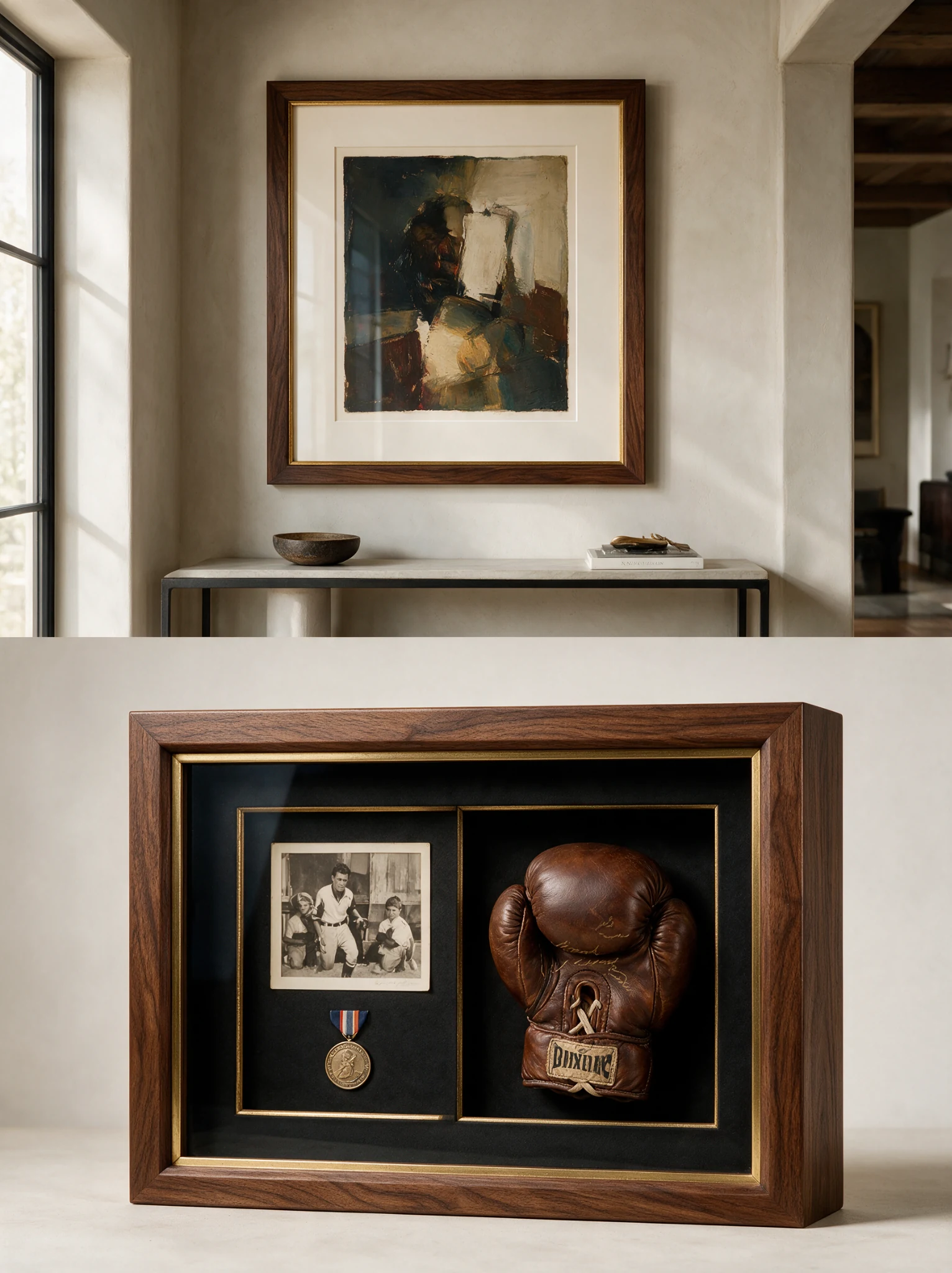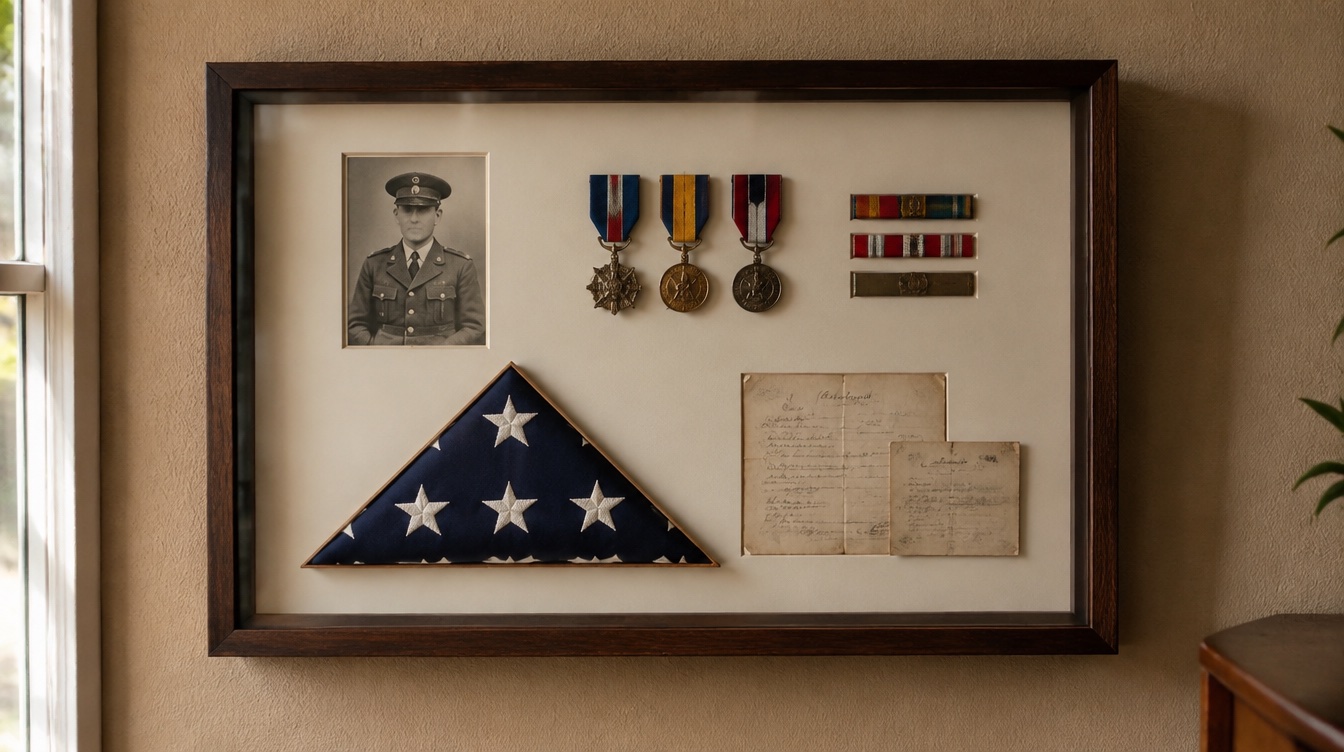
Start with the story, not the size of the frame.
A military display can include medals, ribbons, photographs, patches, commendations, a folded flag, and small personal objects. Trying to give every item equal visual weight usually makes the display harder to read. Begin with the person, service, and moments the collection is meant to honor.
Lay the objects out without attaching anything. Choose one or two focal pieces, then group the rest by significance. A portrait, service photograph, or meaningful document can provide context for medals and insignia without competing for attention.
Plan enough depth for medals, pins, and folded textiles.
Medals and badges are dimensional. Ribbons may sit differently than pins, and a folded flag requires considerably more space than a photograph. A shadow box gives the arrangement enough depth to avoid pressing items against the glazing.
Before committing to a frame profile, measure the deepest object and consider how the pieces will sit together. Spacing, mounting support, and background materials should be selected around the actual objects, not a standard off-the-shelf frame depth.
Choose mounts that respect the objects.
For keepsakes that may be passed between generations, ask how each item will be attached and whether its mounting can be adjusted later. Avoid casually gluing valuable medals, original fabric, photographs, or documents directly to a backing board.
Different objects require different supports. Heavy insignia, delicate paper, and textiles do not behave alike, so the support method should be designed around their condition, weight, and construction. Older or fragile materials may warrant consultation with a qualified conservator.
Consider photographs and documents as part of the composition.
Photographs, letters, certificates, and commendations can turn a collection of objects into a personal history. Their scale matters: a small original photo may work better as a quieter supporting element rather than stretched to fill a large area.
If a document is fragile or irreplaceable, consider whether a carefully made reproduction is more suitable for routine display while the original is stored safely. Talk through matting, backing, glazing, and possible light exposure before framing paper memorabilia.
Make the finished display feel intentional.
Deep walnut, restrained black, warm wood, or a classic profile can each work, depending on the objects and the room. Let the collection lead the palette. A neutral backing often allows ribbons, flags, and metals to stand out without making the presentation busy.
At Masten Fine Framing in Greenwood Village, you can bring the entire collection to a consultation. Reviewing the objects in person makes it easier to plan their hierarchy, spacing, background, frame depth, and a fitting presentation.